
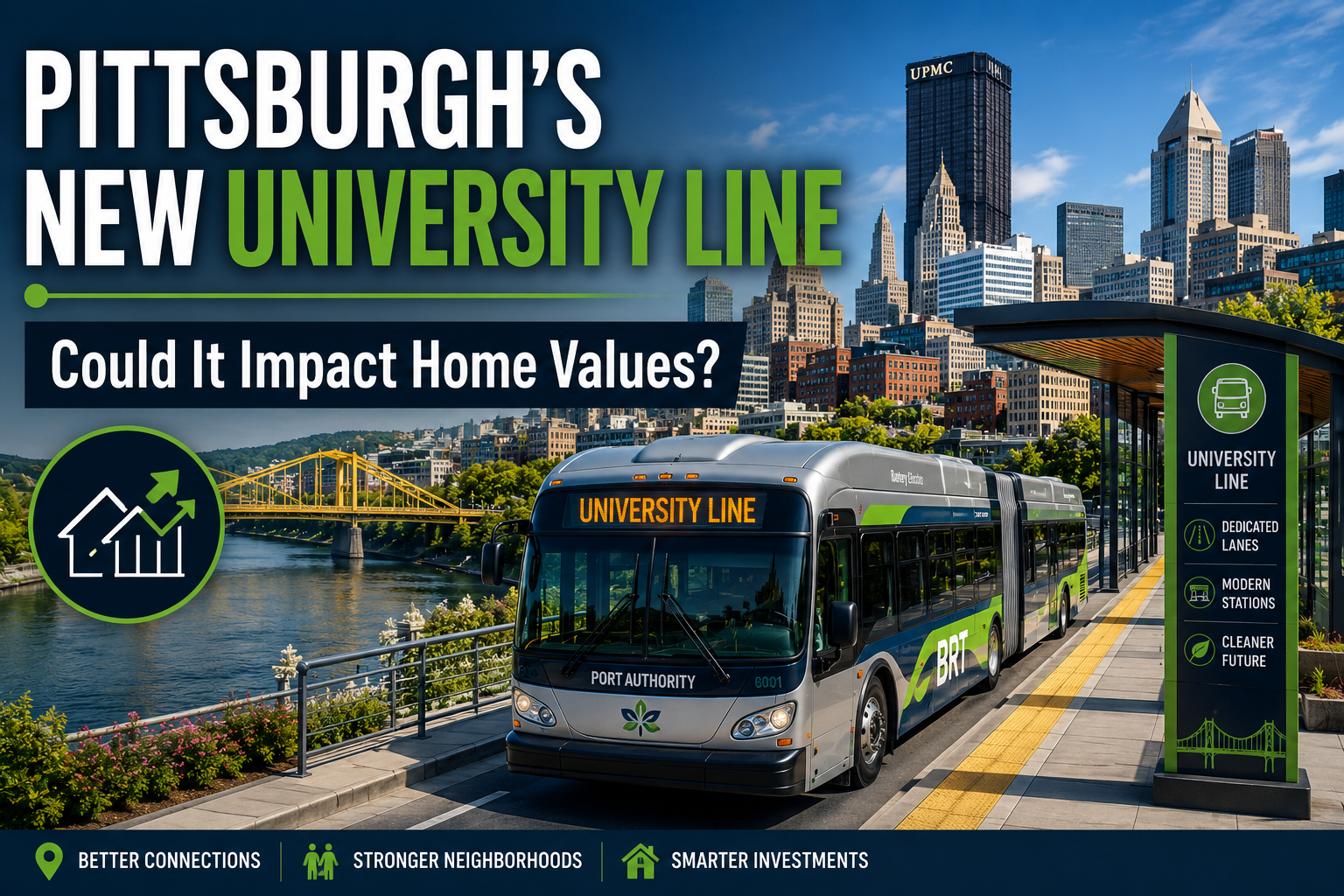
Pittsburgh is in the middle of a major transportation project that could change more than how people get around the city.
The University Line, Pittsburgh Regional Transit’s new bus rapid transit corridor, will connect Downtown, Uptown and Oakland with dedicated bus lanes, upgraded stations, improved sidewalks, protected bike lanes, better lighting and other improvements along the route.
For Pittsburgh homebuyers, sellers and real estate investors, the bigger question is: What could improved transit access mean for the neighborhoods surrounding it?
Why Transit Matters in Real Estate
When buyers compare homes, they aren’t evaluating the house alone.
Commute times, access to employment, hospitals, universities, restaurants and everyday conveniences all influence where people want to live — and what they are willing to pay to live there.
Research has repeatedly found a relationship between high-quality transit access and nearby property values. The effect varies considerably by city, neighborhood, type of transit and even the home’s distance from the station.
That distinction is important.
A home with convenient access to transit may benefit from that accessibility, while a property immediately adjacent to a busy station may have additional noise, traffic or foot traffic that some buyers would rather avoid.
In real estate, location is rarely as simple as “closer is always better.”
East Liberty Shows Us What Can Happen
We already have an interesting example right here in Pittsburgh.
Development surrounding the Martin Luther King Jr. East Busway and East Liberty Transit Center included approximately 360 new homes and more than 40,000 square feet of retail space.
That transit-oriented development became part of a much larger transformation in East Liberty, bringing new housing, businesses and investment into an area that had been overlooked for years.
Transit wasn’t the only reason East Liberty changed, but its accessibility became an important part of the neighborhood’s redevelopment story.
And that’s why the University Line is worth watching.
What Is Pittsburgh’s University Line?
The University Line is a major bus rapid transit project connecting Downtown Pittsburgh, Uptown and Oakland.
The project includes dedicated bus-only lanes, new stations, real-time arrival information, protected bike lanes, new sidewalks, street trees, lighting and traffic-signal improvements.
The corridor will also use battery-electric buses as part of the upgraded fleet.
For anyone familiar with Pittsburgh traffic, the importance of connecting Downtown and Oakland shouldn’t be difficult to understand. Oakland is one of the region’s largest employment, education and medical centers, and improving access between these areas could make neighborhoods along and near the corridor more attractive to people who work there.
Which Pittsburgh Neighborhoods Could Benefit?
The University Line itself runs through the City of Pittsburgh, so areas with convenient access to Downtown, Uptown and Oakland are the most directly connected to the project.
But the larger story isn’t limited to the streets immediately surrounding the route.
Pittsburgh Regional Transit has also studied potential transit improvements extending farther east and toward communities in the Mon Valley.
For buyers and investors thinking long term, those plans are worth watching.
That doesn’t mean buying near a proposed transit project guarantees appreciation. It doesn’t.
But transportation, employment access, new development and infrastructure investment are all factors I consider when helping buyers evaluate where a neighborhood may be heading — not simply where it is today.
What Should Pittsburgh Homebuyers Look For?
If you’re considering a home near a major transit corridor, don’t evaluate it from a map alone.
Visit the property during rush hour. Walk from the house to the station or stop. Pay attention to traffic, noise, lighting and sidewalks. Consider how practical the connection would actually be as part of your daily routine.
There can be a significant difference between technically being “near transit” and having convenient, comfortable access to it.
That’s especially important when you’re relocating to Pittsburgh and don’t already know how our neighborhoods, bridges, tunnels and commuter routes connect.
Sellers Should Be Paying Attention, Too
If you’re selling a Pittsburgh home with genuinely convenient access to employment centers and public transportation, that accessibility can be an important part of your marketing.
For someone relocating from another city, being able to easily reach Downtown, Oakland, hospitals, universities or other major employment centers may be one of the reasons they choose one house over another.
It shouldn’t be buried halfway through a property description.
It should be part of the story you’re telling buyers about what it’s actually like to live there.
The Bigger Pittsburgh Real Estate Story
The University Line isn’t going to make every house near it suddenly worth more.
Real estate doesn’t work that way.
But infrastructure matters. Accessibility matters. Employment centers matter. And when significant public and private investment begins changing how people experience a neighborhood, it’s worth paying attention.
East Liberty gives us a local example of how transit-oriented development can become part of a much larger neighborhood transformation.
Now we have another major transportation investment underway.
The question isn’t simply what Pittsburgh’s University Line will look like when it’s finished.
It’s what the neighborhoods connected to it will look like five or ten years from now.
Thinking about moving to Pittsburgh or Western Pennsylvania? Download my free Pittsburgh Relocation Guide for information on neighborhoods, school districts, cost of living and what you should know before making your move.
Diane McConaghy
Associate Broker | REALTOR®
RE/MAX Select Realty
Real Tips. Real Talk. Real Estate. Helping You Move Smart.